
Choosing Large Cooking Pots for Rice, Curry and Stock: Aluminium versus Stainless Steel
A procurement guide for commercial kitchens balancing heat distribution, fuel consumption, and recipe acidity across high-volume food service.
21 September 2026Every commercial kitchen manager understands the cost of an incorrect vessel on the range. In high-volume food service, boiling starch, simmering rich stocks, and preparing curries are foundational operations where minor inefficiencies compound into severe financial waste. Using a light vessel on an industrial burner scorches a hundred portions of samba rice in minutes, wasting raw ingredients and demanding hours of kitchen porter labour to scour the base. Conversely, choosing the wrong metal for an acid-heavy curry leaches metallic flavours, discolours the sauce, and pits the metal base, forcing premature capital replacement. Managing heat, weight, and metal reactivity is not merely a matter of culinary technique; it directly controls replacement cost, fuel spend, labour hours, and food wastage across your operation.
Thermal Dynamics and Vessel Metallurgy
Commercial cookware selection centres primarily on the physical behaviours of aluminium versus stainless steel under sustained thermal load. Aluminium possesses exceptional thermal conductivity, transferring heat rapidly and distributing it evenly across the cooking floor and up the vessel walls. In heavy-gauge formats, aluminium minimizes concentrated hot spots, making it an efficient medium for bringing large volumes of liquid to a boil and dispersing high BTU outputs. However, aluminium is chemically reactive to acids and alkalis, which oxidises the surface and can taint delicate sauces if used indiscriminately.
Commercial stainless steel, by contrast, is an inert, highly durable alloy that does not react with acidic ingredients, preserving the exact flavour profile and colour of long-simmered preparations. Because solid stainless steel is a poor conductor of heat on its own, high-performance catering vessels utilize a sandwich-base (an encapsulated core of aluminium or copper bonded between layers of stainless steel). This multi-layer base diffuses fierce direct flame across the full floor of the vessel, preventing localized scorching while the hard stainless steel interior resists mechanical abrasion from heavy paddles, strainers, and scouring pads.
Volume Operations Under Sri Lankan and Island Conditions
Kitchens across Sri Lanka and Maldives resorts operate under intense atmospheric and culinary pressures. High coastal humidity and salt air accelerate exterior corrosion on inferior metals, while the daily monsoon dampness punishes poorly welded joints and rivet seams. Cooking on high-pressure gas burners demands robust vessel construction with solid riveted handles that will not shear under the shifting weight of 25 to 100 litres of boiling liquid. Moreover, local menus introduce severe chemical and thermal demands that dictate strict vessel zoning between your aluminium and stainless steel inventory.
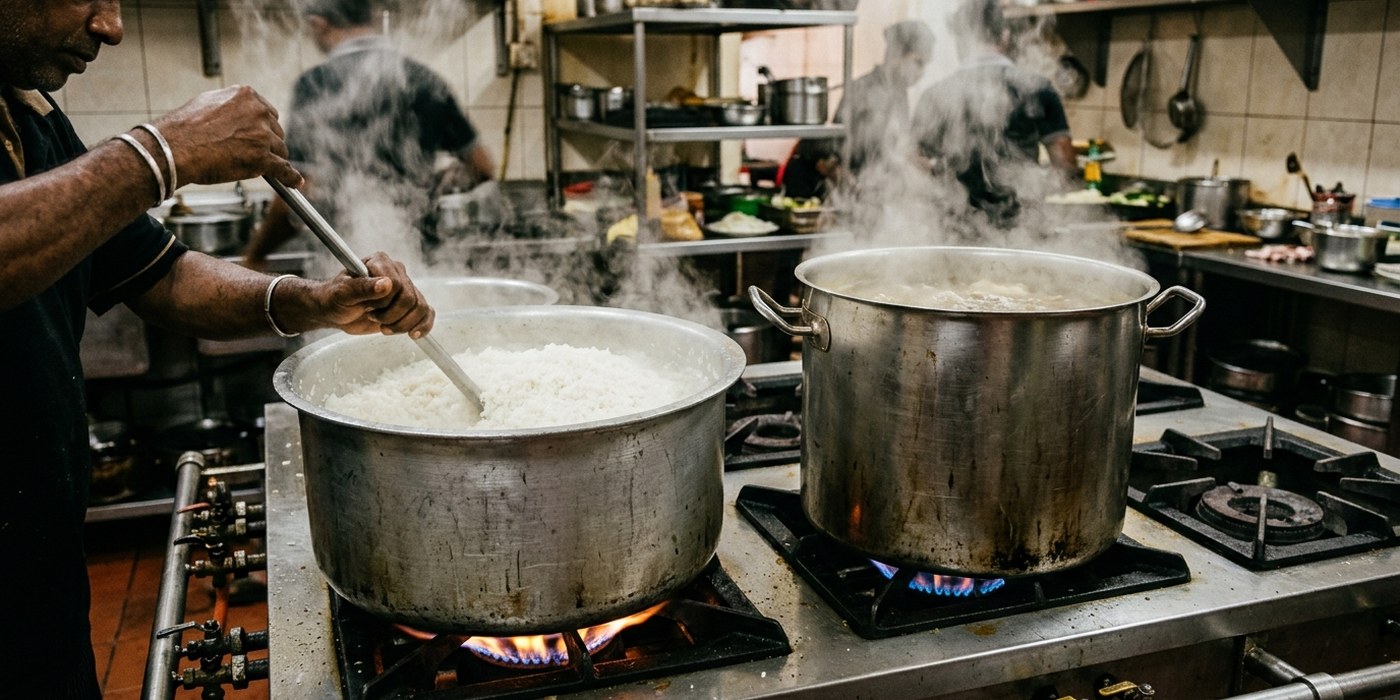
Rice and Dhal Preparation: High-volume lunch lines require vast quantities of staple starches. For plain white rice, samba, or boiling dhal, vessels from our Aluminium ware category—specifically heavy-gauge pots from the Heavy duty cooking pots, thachchi & Strainers (Colander's) subcategory—offer superior thermal responsiveness. They heat quickly, reducing gas consumption during the primary boil, and respond immediately when the burner is dialed back for steaming. For standard operations, our broader Cooking pots, Athili, Thachchi, Jugs, Rotti plates & Kettles subcategory supports preparation alongside our Rice Cooker's & Toasters subcategory. Handling these batches requires durable tools from the Turners, Lifters & Scrapers subcategory and Spoons, Rolling pins & Piston and Mortar subcategory to turn grains without crushing them.
Acidic Curries and Stews: The fundamental challenge in Sri Lankan cooking is the presence of potent tenderising acids: goraka (Garcinia cambogia) in ambul thiyal, sour tamarind pastes, and fresh lime juice squeezed over curries, gravies, and pol sambol accompaniments. Simmering sour fish curries, spicy chicken curries, or tomato-rich gravies in bare aluminium causes a chemical reaction that pits the pot interior and introduces an off-taste. These preparations belong strictly inside the Stainless Steel Ware range. Operators should utilize sandwich-base vessels from the Containers with lid (Stock pots) subcategory. The inert interior resists corrosion from boiling acids, while the tight-fitting lids retain moisture over extended reductions.
Stock Production, Straining, and Holding: Long-simmered bone broths and stocks for hotel buffets and catering services require continuous low-heat circulation. Sandwich-base stainless vessels maintain thermal stability over twelve-hour cycles on high-pressure burners. Skimming and decanting operations are executed cleanly using tools from the Oil Strainers, Colanders subcategory, Tea, milk & juice strainers subcategory, and Serving Spoons & Turners subcategory. For rapid prep, operators turn to the S/S Woks, Thachchi, Wok Spoons & Shovels subcategory or utility tools in the Cooking Utensils subcategory.
Buffet Transport and Holding: Once bulk cooking concludes, the food must transfer efficiently without loss of heat or flavour. In high-turnover breakfast shifts serving kiritea, string hoppers, and curries, dishes transition seamlessly into the Buffet Items range, utilizing vessels from the Chafing Dishes subcategory and standardized GN Pans (Inserts) subcategory. Bulk beverage transport relies on our Insulated Hot & Cold Tea Urns & Beverage Dispensers subcategory, while transport between central commissaries and satellite venues is maintained safely using the S/S Food Carriers with Lid & Buckets subcategory.
Commercial Cookware Comparison Matrix
| Operational Metric | Heavy-Gauge Aluminium Stock Pots | Sandwich-Base Stainless Steel Pots |
|---|---|---|
| Primary Kitchen Application | Boiling bulk rice (10 kg to 50 kg dry weight), dhal, boiling water, initial stock reduction. | Goraka-based curries, tamarind fish ambul thiyal, tomato sauces, acidic stocks, delicate milk reductions. |
| Thermal Response & Conductivity | Extremely rapid heat transfer; heats the entire wall; reduces pre-boil time on industrial burners. | Base-driven heat distribution via encapsulated core; superior heat retention for steady simmering. |
| Acid & Chemical Resistance | Reactive; subject to surface etching and grey oxidation when exposed to lime, tamarind, or vinegar. | Completely non-reactive; preserves exact sauce colour, spice chemistry, and flavour clarity. |
| Vessel Weight & Ergonomics | Lighter tare weight; easier for kitchen staff to lift, wash, and invert during drainage. | Substantially heavier; demands secure, heavy-duty riveted handles for dual-porter handling. |
| Scouring & Maintenance Labour | Requires softer abrasive pads; harsh caustic dishwashing chemicals cause exterior dark staining. | Resists aggressive mechanical scrubbing, wire scouring, and harsh detergents without base wear. |
| Procurement & Lifespan Cost | Lower initial capital expenditure; cost-effective for neutral, non-acidic bulk cooking tasks. | Higher initial outlay; exceptional long-term ROI through chemical inertness and impact resistance. |
Practical Vessel Selection and Care Checklist
- Check Handle Fastening: Large pots holding 25L to 100L must have multi-point, heavy-duty riveted handles. Avoid light spot-welded side loops that fail under shifting liquid loads.
- Audit Recipe Acidity: Keep a strict operational rule: if a preparation uses goraka, tamarind, lime juice, vinegar, or concentrated tomato, mandate stainless steel to prevent metallic off-flavours.
- Match Base Diameter to Burner Ring: Ensure the pot base fully covers the flame ring. An undersized pot allows intense heat to bypass the sides, blistering handles and scorching the perimeter.
- Enforce De-glazing Over Hard Scraping: Train stewarding teams to soften scorched starch with hot water and alkali-free cleaners rather than striking pot bases with metal cleavers.
- Procurement Logistics: All professional cookware is sold by the piece, discounts for quantities, allowing catering teams to mix aluminium and stainless inventories to exact brigade requirements.
Every commercial kitchen requires an intentional balance between rapid thermal response and chemical resilience. Outfitting your line with the right cookware stops recurring ingredient loss, limits monthly gas burn, and reduces steward labour. To inspect handle assemblies, metal gauges, and lid seals firsthand, visit our Pettah showroom at 98 Main Street, Pettah, Colombo 11, where we have supported professional caterers and hoteliers since 1924. You can also contact our institutional sales team directly on WhatsApp at +94 71 076 7600, email your purchase schedules to quotations@titusstores.com, or receive immediate procurement guidance through TitusGPT at titusstores.com. Titus Stores provides free delivery in Sri Lanka on orders over Rs 5,000 to streamline your equipment procurement.